
British Standard Pipe Thread /SAE
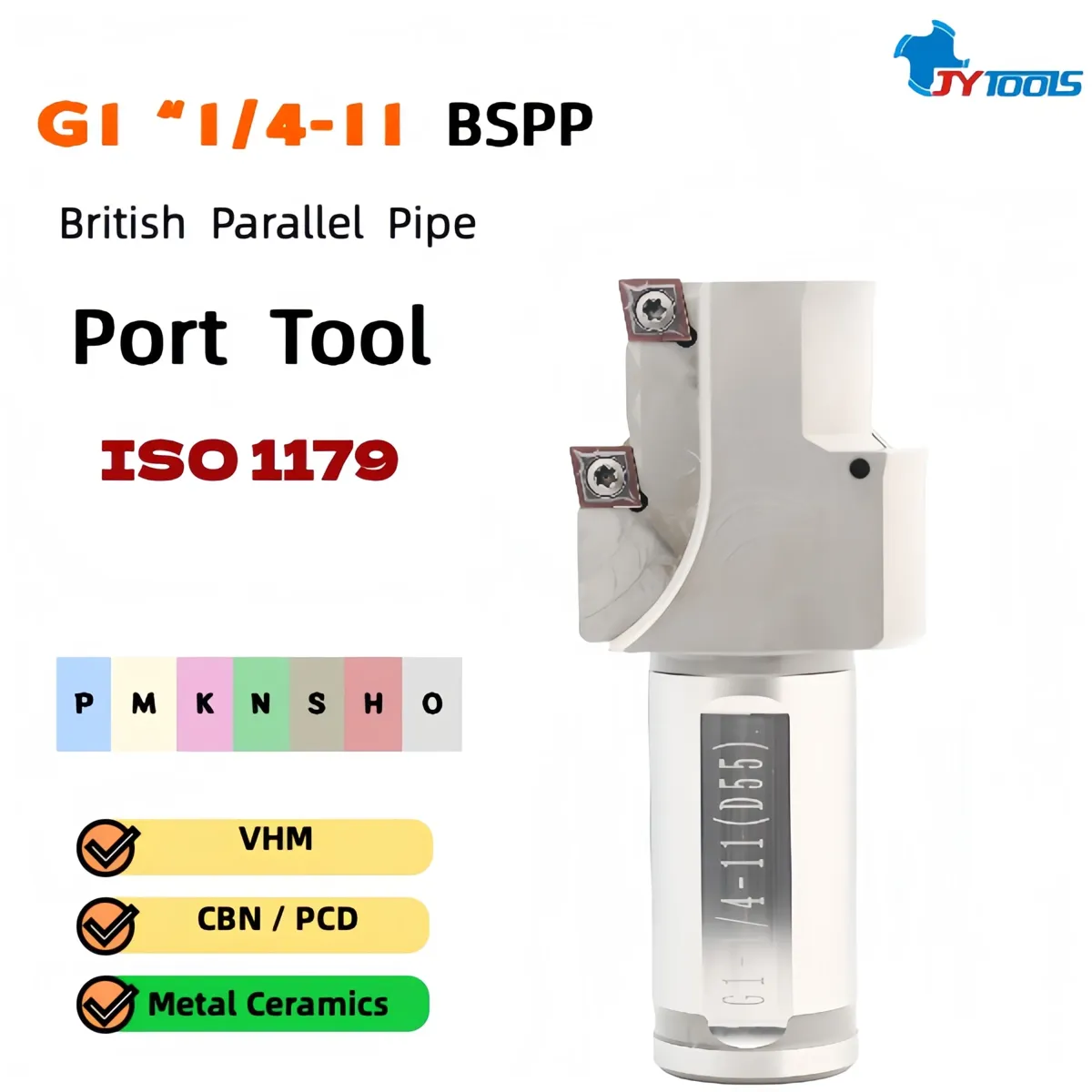
In hydraulic and pneumatic system machining, the sealing performance of BSPP interfaces depends on precision. Our BSPP port tools are designed specifically for the ISO 1179-1 standard, integrating a pilot hole, sealing angle, and spotface into a single tool. Traditional BSPP interface machining often requires multiple tool changes using drills, reamers, and countersinks, wasting time and increasing the risk of platen defects leading to oil leaks. Choosing our professional BSPP port tools will result in a 60% reduction in machining time, zero defect rate, and an extended service life. Suitable for various applications: A single tool body can efficiently and precisely ream multiple hole sizes at different diameters. Because the cutting part is a carbide plate, it reduces tooling costs and extends tool life. Port tool types: High-speed steel FA type / Morse taper shank FB type / Carbide FC type / Replaceable insert FD type / Welded cermet FR type
| Part number | G 1" 1/4-11 FD315 |
|---|---|
| Type | Indexable FD type |
| Product Name | SAE Port Profile Cutting Machine |
| OEM / ODM | Made to your samples or drawings |
| Specifications | G 1" 1/4-11 |
| Origin | Shenzhen, China |
Design details engineered for accuracy, tool life and process stability.
Avoids cam misalignment caused by multiple tool changes, ensuring absolute perpendicularity between the thread and the sealing surface, crucial for preventing interface leakage.
Due to their indexable inserts, intermittent cutting is less prone to chipping, and the tool body is more stable and less prone to vibration. Particularly suitable for casting skins, porosity, and non-uniform materials.
One insert with multiple cutting edges; insert wear → direct repositioning. The tool body can be used for a long time, reducing the tooling cost per valve body by 30–50%.
Indexable port tools, with their repeatable and indexable design, offer high material removal efficiency and strong impact resistance. The inserts can be repositioned multiple times, making them particularly suitable for castings and large-mass machining, significantly reducing per-piece machining costs.
Compared to solid carbide port tools, they offer higher wear resistance, faster spindle speeds, negative rake angle or reinforced cutting edge, and a high-rigidity integral tool body. Insert wear → direct repositioning.
Typical industries and parts machined with this tool.
Handling pipe fittings made of corrosion-resistant materials (such as bronze or duplex stainless steel) in extremely demanding operating environments.
Machining hydraulic valve blocks, pump bodies, and actuator connection ports to ensure leak-free operation under high pressure.
Manufacturing precision pneumatic control valves and spindle interfaces to accommodate pressure switching.
Ensuring smooth, seamless piping connections that meet hygienic cleaning standards.
Machining lightweight manifolds for consumable and cooling systems.
Tell us the port standard and thread size. We supply port contour cutters in standard sizes or made to your samples or drawings.